

Interstitial Journaling: A Simple Method to Improve Focus and Reduce Overwhelm
Learn how interstitial journaling helps clear mental clutter, improve focus, and reduce overwhelm using a simple, research-backed method.
You know that moment when you open a new tab… and immediately forget why you opened it?
Or you walk from one meeting into the next and suddenly feel like your brain is… buffering?
That’s not a motivation problem. It’s not a discipline problem. It’s a transition problem.
What interstitial journaling actually is
Interstitial journaling is a deliberately small pause between tasks where you write down what’s happening in your head before moving on.
Not a full journal entry. Not reflection. Not planning.
Just a quick, intentional reset that helps your brain let go of one thing before picking up the next.
Why switching tasks quietly drains your brain
Most people think productivity is about starting. In reality, it’s about switching.
Every time you move from one task to another, part of your attention stays behind. This is called attention residue (Leroy, 2009).
Which explains why you can:
- reread the same sentence three times
- open a document and stare at it
- feel busy but oddly unfocused
The cognitive load problem (in plain English)
Your brain is not designed to hold everything at once.
Working memory is limited. When it’s overloaded, performance drops (Sweller, 1988).
So when you try to carry unfinished thoughts from one task into another, you’re effectively running too many tabs at once.
What this looks like in real life
Instead of clean transitions, your day feels like:
- overlapping conversations
- half-finished thoughts
- constant low-level stress
Not dramatic. Just… noisy.
How interstitial journaling fixes this
By writing things down between tasks, you’re doing something called cognitive offloading.
You’re moving information out of your brain and onto paper, which reduces mental strain and improves focus (Risko & Gilbert, 2016).
In practical terms, you’re telling your brain:
“You don’t need to hold this anymore.”
How to do it (the 30-second version)
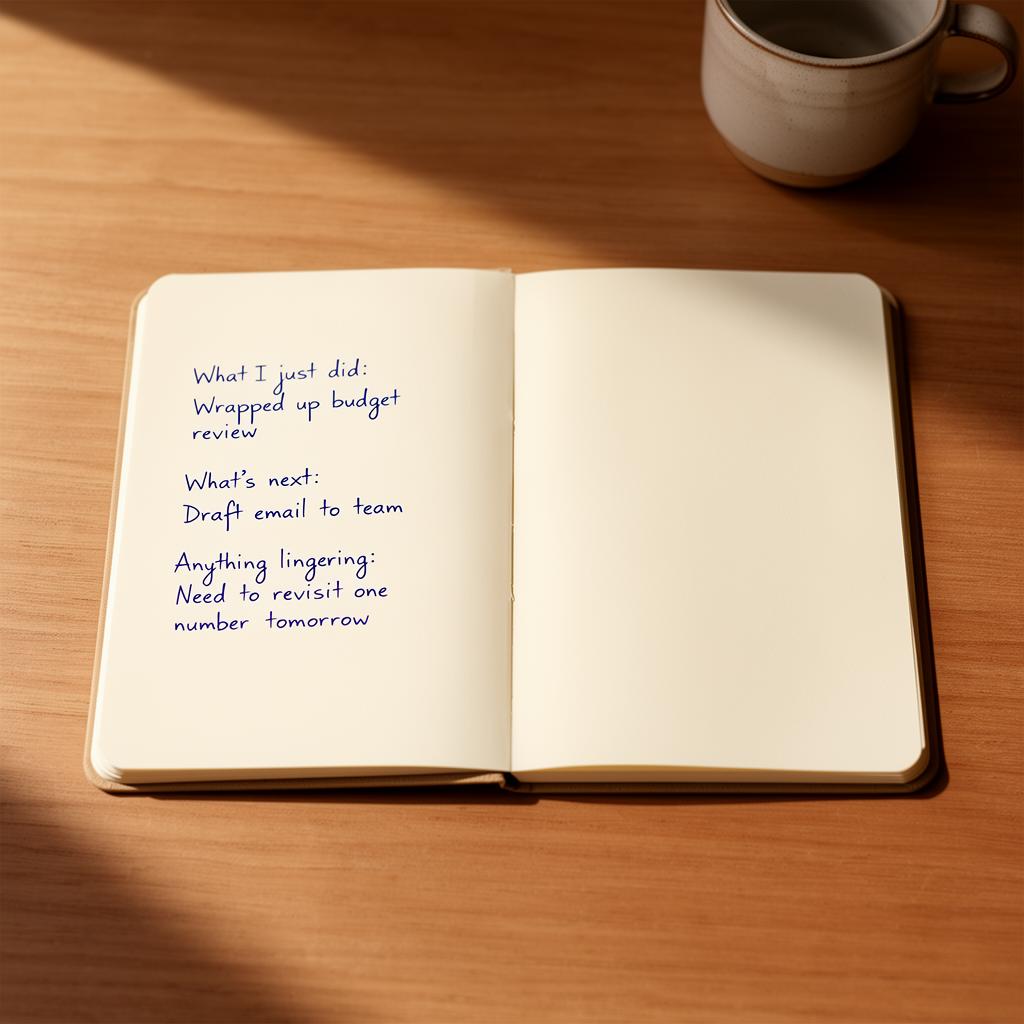
Open your journal and write three lines:
- What I just did
- What I’m about to do
- Anything still in my head
That’s it. No formatting. No overthinking.
Example
- Wrapped up budget review
- Next: draft proposal
- Still thinking about one number—check later
That small act closes the loop.
When to use this (hint: more often than you think)
This works best:
- between meetings
- before starting something you’ve been avoiding
- when your brain feels scattered
- at the end of the day
Why this works better than “just focusing harder”
Most advice tells you to push through.
But if your brain is overloaded, pushing harder just increases friction.
Interstitial journaling reduces friction instead.
Start here
At your next transition, write one line:
What I just did / What’s next.
That’s enough to change how the next hour feels.
References
Leroy, S. (2009). Why is it so hard to do my work? Organizational Behavior and Human Decision Processes, 109(2), 168–181.
Risko, E. F., & Gilbert, S. J. (2016). Cognitive offloading. Trends in Cognitive Sciences, 20(9), 676–688.
Sweller, J. (1988). Cognitive load during problem solving. Cognitive Science, 12(2), 257–285.
Designed for how your mind actually works.
Not how it’s “supposed” to.