

Decision Fatigue Explained: Why Simple Choices Feel So Hard
Struggling to make decisions late in the day? Learn how decision fatigue works and how to reduce it with simple, science-backed strategies.
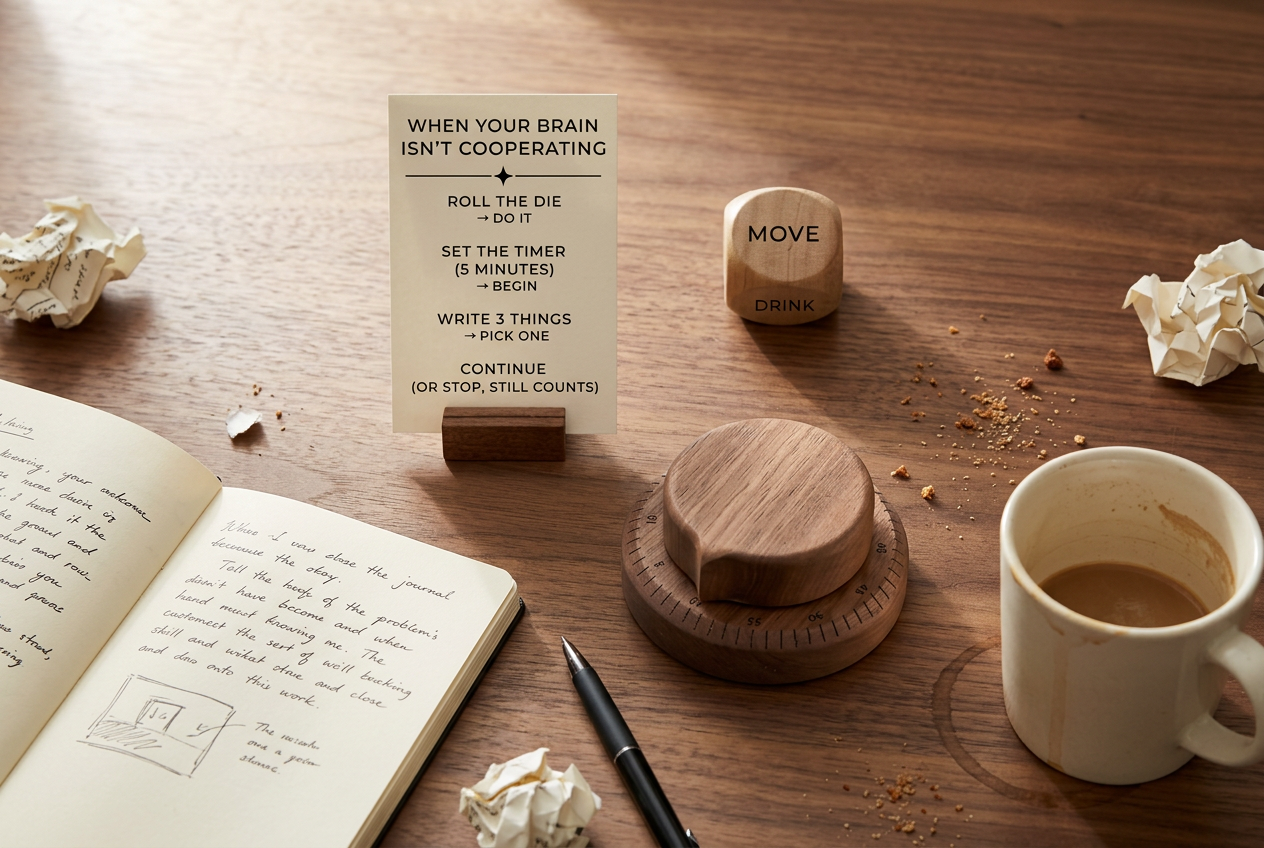
Let’s be honest
At 9am, you can decide things.
At 4pm?
You stare at:
- what to reply
- what to eat (and what to feed everyone else!)
- what to do next
…and somehow, even simple choices feel… heavy.
So you:
- delay
- avoid
- default
Or spend 10 minutes deciding something that should take 10 seconds.
This isn’t random
It’s called decision fatigue.
And it’s exactly what it sounds like.
The more decisions you make, the harder it becomes to make the next one.
What’s happening under the surface
Every decision—big or small—uses mental energy.
Not just:
- strategic decisions
- important decisions
But:
- what email to answer
- what message to send
- what to work on next
Research shows that after repeated decision-making, people experience reduced self-control and impaired judgment (Vohs et al., 2008).
Not because they stopped caring.
Because they’re mentally depleted.
What this looks like in real life
Decision fatigue doesn’t feel dramatic.
It feels like:
- “I’ll do it later”
- “I don’t know, it depends”
- “Let me think about it”
Or:
- picking the easiest option
- avoiding decisions entirely
- overthinking small choices
Why this matters more than you think
Because decision fatigue doesn’t just slow you down.
It changes your behavior.
You become more likely to:
- procrastinate
- choose convenience over importance
- defer things that actually matter
The mistake most people make
They assume they need to:
- try harder
- be more disciplined
- “just decide”
But if the issue is energy, not effort…
That approach backfires.
The real solution: reduce the number of decisions
Not better decisions.
Fewer decisions.
That’s the shift.
What this looks like in practice
You simplify wherever possible:
- pre-decide meals
- batch similar tasks
- reduce options
Instead of:
“What should I do next?”
You already know.
Small changes that make a big difference
You don’t need a full system overhaul.
Start with:
- limiting your daily priorities (hello, 3 Things)
- using simple rules (“if X, then Y”)
- deciding earlier in the day
A surprisingly effective trick
When you’re stuck between options:
Don’t expand.
Reduce.
From:
- 5 options → 2
- 2 options → 1
Your brain doesn’t need more possibilities.
It needs less.
Why tools help
When you use:
- a journal
- a structured system
- even a simple decision tool
You’re not adding complexity.
You’re removing the need to decide from scratch every time.
The real benefit
Less decision fatigue means:
- more mental energy
- clearer thinking
- faster action
Not because you became better.
Because you removed friction.
Start here
Pick one area of your day and reduce decisions.
Just one.
That’s enough to feel the difference.
Where this fits in your system
Decision fatigue connects directly to:
- 3 Things system → fewer daily decisions
- Brain dump → less to mentally manage
References
Vohs, K. D., Baumeister, R. F., Schmeichel, B. J., Twenge, J. M., Nelson, N. M., & Tice, D. M. (2008). Making choices impairs subsequent self-control: A limited-resource account of decision making, self-regulation, and active initiative. Journal of Personality and Social Psychology, 94(5), 883–898.
Designed for how your mind actually works.
Not how it’s “supposed” to.