

How to Use the Executive FUNction System (Without Overthinking It)
A simple, practical guide to using your Executive FUNction tools to reduce overwhelm and move forward with clarity.
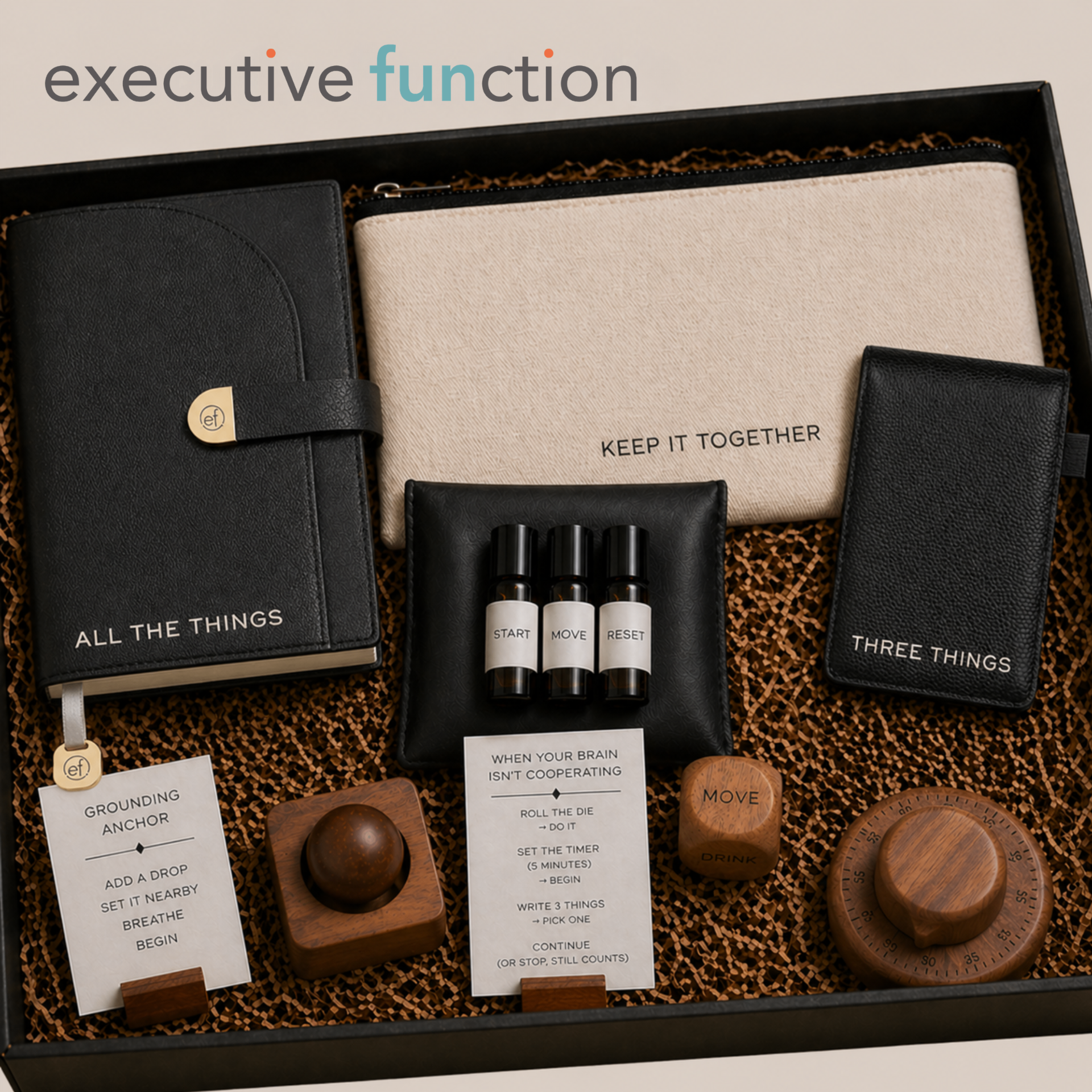
A simple, research-backed way to reduce overwhelm and move forward—without trying to become a different person.
Let’s start with the truth
There is no “perfect” way to use this system.
That’s the point.
It’s not another productivity method that expects you to:
- wake up at 5am
- optimize every minute
- or suddenly become someone who “loves systems”
It’s designed for how your mind actually works.
Not how it’s “supposed” to.
What’s really going on
When things feel hard, it’s usually not a motivation problem.
It’s a load problem.
Your brain is:
- holding too many things
- choosing between too many options
- or struggling to start
So instead of pushing harder, the system does something else:
It reduces the load in three specific areas — cognitive load, decision load, and activation friction.
The system (three simple moves)
You don’t need to use everything at once.
Start with the one that matches how your brain feels right now.
1. All the Things (reduce cognitive load)
When your brain feels like 47 tabs are open and none are loading:
Don’t organize. Don’t prioritize.
Just:
- write everything down
- get it out of your head
- keep going until it’s quieter
This works because your brain isn’t meant to store everything—just to process it.
Once it’s out, things stop competing for attention.
2. Three Things (reduce decision load)
Now you have a list.
Which… is somehow worse.
Because now your brain has to decide what matters before you can start.
So instead, you choose:
- just three things
Not everything that’s urgent.
Not everything that “should” get done.
Just:
- three meaningful
- actually doable
- forward-moving things
Now the question changes from:
“What should I do?”
to:
“Which one do I start?”
That’s a much easier question.
3. Take Action (reduce activation friction)
This is where most systems break.
Not because you don’t know what to do—
but because starting feels weirdly hard.
So instead of relying on willpower, you change the conditions around the behavior.
You make action easier than avoidance.
That can look like:
- Roll the decision die
→ remove the “what should I do?” loop
→ do the thing it lands on - Set a short timer (5–10 minutes)
→ you’re not committing to the task
→ just to starting - Lower the bar dramatically
→ open the document
→ write one line
→ take one step - Use a quick reset (like interstitial journaling)
→ “what did I just do?”
→ “what’s next?”
None of these are complicated.
That’s the point.
They work because they reduce activation energy—the invisible barrier between knowing and doing.
What this actually looks like in real life
Morning
- brain dump (“all the things”)
- choose three things
Midday (when things start to drift)
- pick one of your three
- use a timer or die to start
Afternoon (when decisions feel heavier than they should)
- don’t renegotiate your entire day
- go back to your three
End of day
- note what’s done
- capture what’s next (so tomorrow doesn’t start from zero)
When your brain is not cooperating
Don’t scale the system.
Shrink it.
Instead of:
- all the things
- three things
- full reset
Just:
- write one thing
- take one step
That counts.
Momentum > perfection.
What not to do
This matters.
Don’t:
- try to use everything at once
- over-engineer the system
- turn it into another thing you’re “bad at”
This isn’t about doing it right.
It’s about making it easier to begin.
The actual goal
Not productivity.
Not optimization.
Clarity.
Momentum.
A little less noise in your head.
Where to start
If you’re not sure:
→ Start with All the Things (get it out)
→ Move to Three Things (choose what matters)
→ Use Take Action (make it easier to begin)
The system, simply
All the Things = reduce cognitive load
Three Things = reduce decision load
Take Action = reduce activation friction
Designed for how your mind actually works.
Not how it’s “supposed” to.